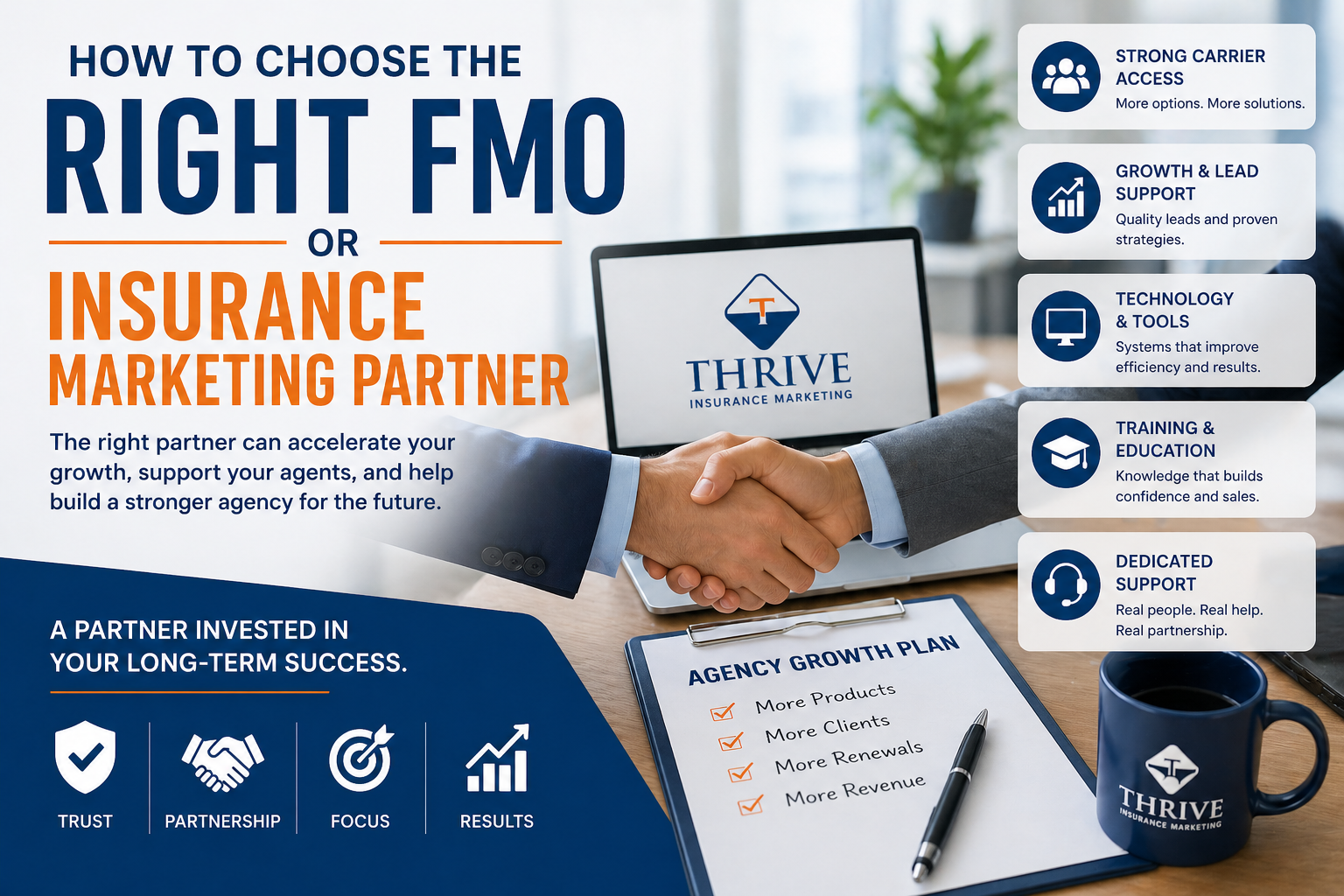
For independent insurance agents, choosing the right FMO can shape the future of the entire business.
An FMO, or Field Marketing Organization, does much more than provide carrier contracts. The right partner helps agents grow faster, improve operations, access better products, strengthen client retention, and build long-term business stability.
The wrong partner can create delays, weak support, limited opportunities, and frustration that slows growth.
This is why selecting the right insurance marketing organization is one of the most important decisions an independent agent can make.
Many agents only compare commissions when choosing an FMO. While compensation matters, the real long-term value comes from support, systems, training, technology, and strategic guidance.
In this guide, we will explain how to evaluate an FMO properly, what questions to ask, and how to choose a partner that supports real business growth.
What Is an FMO?
FMO stands for Field Marketing Organization.
An FMO helps independent insurance agents by providing access to carriers, products, training, contracting support, technology tools, compliance guidance, and operational resources.
FMOs often support agents across multiple product lines such as:
- Medicare Advantage
- Medicare Supplement
- Prescription Drug Plans
- ACA and Health Insurance
- Life Insurance
- Final Expense
- Annuities
- Long-Term Care
- Supplemental Products
Instead of working directly with every carrier individually, agents often work through an FMO to simplify access and improve support.
A strong FMO becomes a long-term business partner, not just a contract provider.
Why Choosing the Right FMO Matters
Your FMO directly affects your ability to grow.
The right partner improves:
- Speed of contracting
- Carrier access
- Lead opportunities
- Sales training
- Product knowledge
- Client retention support
- Technology systems
- Compliance confidence
- Commission visibility
- Long-term scalability
The wrong partner creates:
- Slow onboarding
- Poor communication
- Limited product options
- Weak service support
- Administrative frustration
- Lost sales opportunities
Many agents stay with the wrong FMO simply because changing feels difficult.
But poor support costs more than switching.
Your growth depends on who is helping you behind the scenes.
1. Look Beyond Commission Levels
Many agents start by asking one question:
“What are the commission levels?”
This is important, but it should never be the only factor.
A slightly higher commission means very little if the FMO provides weak support, poor onboarding, or limited growth opportunities.
Ask instead:
- How quickly do they respond?
- Do they help solve problems?
- Do they provide strong training?
- Can they support long-term growth?
- Do they help improve retention?
- Do they offer strong technology tools?
The best FMO decision is based on total business value, not only compensation.
Growth comes from systems, not percentages alone.
2. Evaluate Carrier Access and Product Strength
A strong FMO should provide broad access to quality carriers and competitive product options.
This allows agents to serve clients properly instead of forcing limited solutions.
Look for support across:
- Medicare Advantage carriers
- Medicare Supplement options
- PDP plans
- ACA and under-65 health products
- Life insurance carriers
- Final expense programs
- Annuities
- Long-term care solutions
- Supplemental health products
Product flexibility improves:
- Client satisfaction
- Retention
- Referral opportunities
- Cross-selling potential
If an FMO limits your ability to serve clients fully, growth becomes harder.
Strong product access creates stronger long-term business.
3. Review Contracting and Onboarding Support
Many agents underestimate how important onboarding support really is.
Poor contracting processes create:
- Delayed sales
- Missed enrollment opportunities
- Frustration during expansion
- Administrative mistakes
A strong FMO should make onboarding simple and efficient.
This includes:
- Fast contracting
- Clear status updates
- Carrier guidance
- Licensing support
- Certification assistance
- Producer onboarding systems
Growth slows quickly when onboarding becomes difficult.
Strong operational support creates faster production.
4. Technology Should Be Part of the PartnershipModern agencies need more than contracts.
Technology support is now one of the biggest differences between average FMOs and growth-focused partners.
Important tools may include:
- CRM systems
- Lead management platforms
- Quoting tools
- Enrollment support
- Commission tracking
- Reporting dashboards
- Producer management systems
- Client retention workflows
Technology improves:
- Efficiency
- Follow-up consistency
- Team coordination
- Lead conversion
- Client retention
An FMO that supports technology helps agents scale with less operational stress.
Without strong systems, growth becomes difficult to manage.
5. Training and Education Should Be Ongoing
The insurance industry changes constantly.
Products change. Carriers change. Compliance changes. Enrollment strategies change.
Agents need more than one-time onboarding.
The right FMO should provide ongoing support through:
- Product training
- Sales strategy sessions
- Medicare updates
- Compliance education
- Market insights
- Enrollment preparation
- Leadership development
Training improves confidence and production.
Agents who continue learning close more sales and create stronger client relationships.
Education should be part of the partnership, not an extra service.
6. Ask About Lead Support and Growth Strategy
Many agents want lead support, but not every FMO offers strong lead programs.
Ask clearly:
- Do they provide lead programs?
- Are leads exclusive or shared?
- How is lead quality managed?
- Do they help with referral systems?
- Do they support local marketing strategies?
- Do they provide CRM follow-up guidance?
Lead generation support should focus on quality, not just volume.
Strong lead systems improve:
- Sales consistency
- Appointment quality
- Retention opportunities
- Revenue predictability
Growth should be intentional, not random.
7. Compliance and Service Support Matter More Than Most Agents Expect
Strong compliance support protects both agents and clients.
This is especially important in:
- Medicare sales
- ACA enrollments
- Life insurance documentation
- Long-term care planning
A strong FMO helps with:
- Compliance guidance
- Documentation standards
- Enrollment accuracy
- Carrier communication
- Service issue resolution
When problems happen, support matters.
Fast service often protects retention more than the original sale itself.
Agents should never feel alone when handling client issues.
8. Reputation and Stability Should Be Reviewed Carefully
Before choosing an FMO, look at long-term reputation.
Ask:
- How long have they been in business?
- Do agents stay long-term?
- Is leadership stable?
- Do they grow with their agents?
- Are they known for support or only recruiting?
A strong reputation usually reflects strong operations.
The goal is not finding the loudest company.
The goal is finding the most dependable partner.
Consistency matters more than promises.
9. The Right FMO Should Support Agency Growth, Not Just Individual Sales
Some agents only think about personal production.
But long-term growth often means building a team, expanding producers, and creating a scalable agency model.
A growth-focused FMO should support:
- Recruiting agents
- Producer onboarding
- Team management
- Reporting systems
- Downline support
- Agency structure planning
This becomes critical for agency owners who want to scale beyond individual sales.
Growth should be built intentionally.
Your FMO should help support that vision.
Questions Every Agent Should Ask Before Joining an FMO
Before making a decision, ask:
How fast is contracting and onboarding?
What technology tools are included?
What training support is available year-round?
Which carriers and product lines are strongest?
How does lead support work?
What happens when service problems arise?
How are commissions tracked and reported?
How do they support long-term agency growth?
The answers often reveal far more than commission numbers.
Common Mistakes Agents Make When Choosing an FMO
Many agents make avoidable mistakes.
Common problems include:
Choosing Based Only on Commission
Short-term thinking often creates long-term frustration.
Ignoring Service Quality
Fast support matters more than most agents realize.
Weak Product Access
Limited carriers reduce growth opportunities.
No Technology Support
Manual systems slow scaling.
No Long-Term Strategy
Agents need business support, not only contracts.
Staying Too Long with the Wrong Partner
Poor support creates hidden losses over time.
Avoiding these mistakes can change the future of an agency.
Final Thoughts
Choosing the right FMO is one of the most important business decisions an independent insurance agent will make.
The best partner provides more than contracts.
They provide:
- Strong product access
- Technology support
- Lead strategies
- Training and education
- Fast onboarding
- Compliance guidance
- Long-term agency growth systems
The goal is not simply to sell more this month.
The goal is to build a stronger business for years to come.
At Thrive Insurance Marketing, we work with agents as true long-term partners. From products and contracting to technology, CRM systems, Medicare growth, lead support, and agency development, our focus is simple:
Help independent agents grow smarter, stronger, and with more confidence.
If you are looking for an insurance marketing partner that supports real business growth, Thrive is ready to help.